“You can feel the air moving in here” says HVAC and Energy Manager Diane Zekind, noting that the newly installed energy-efficient fans in Seabury’s natatorium have noticeably improved the room’s climate. A part of the fan’s energy efficiency is their size. At 18 feet long, these fans turned on high will send a piece of paper flurrying across the room. Their ability to circulate both warm air in the winter and cool air the rest of the year will reduce the number of months the school will need run their central chillers. In the winter, Zekind expects the increased circulation to enable setting the thermostat a little lower than usual.
The high-output fans, also installed in Seabury’s pool and in Woods-Penniman, are part of several energy-saving retrofits recently implemented on campus. Beginning in March of 2012, over 400 lighting fixtures were replaced with more efficient light bulbs and ballasts, LED lights were installed in 43 exit signs, and approximately 280 ceiling and wall sensors to operate lights only when people are in the vicinity were installed in Seabury, Woods-Penniman, Bingham Residence Hall, and Woodcraft. In Seabury, lighting retrofits mainly replaced metal halide lights with T5HO fluorescent fixtures and induction lights which reduce wattage by 40-60%. Also in Seabury, a new pool cover will help retain water temperature and decrease evaporation. Initial analysis has shown the cover reduces the amount of water needed to keep the pool filled by about 20%.
Considering that electricity accounts for about 65% of the College’s energy consumption and approximately 59% of the school’s budget, averages which mirror national energy consumption trends in the commercial sector these upgrades are an important step in reducing the school’s ecological footprint. For a college with a high ratio of indoor square-footage per student, this is no small feat. Yet analysis of the past twelve years’ energy consumption has shown positive results. [Further information in Note 1, below.]
According to the October 2012 Sustainability Progress Indicators Report prepared by the Office of Operations and Sustainability, longer-term record keeping has shown that overall energy consumption for Fiscal Year 2012 was 53% less than the 1998-99 baseline. These improvements in both the consumption of heating and electrical BTU’s have occurred even despite an increase in both square footage and student and staff populations, as well as the addition of air-conditioning as older buildings are renovated. Overall that translates to a decrease in per capita energy use of 55.1%.
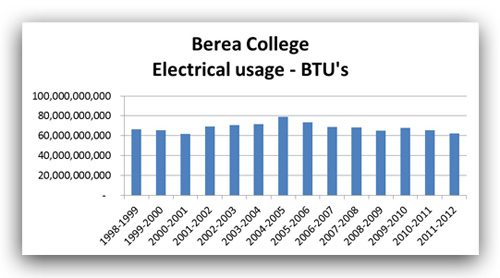
The savings from these and other projects will be used toward further energy efficiency upgrades. Diane Zekind warns that discerning accurate cost-savings and energy-use analysis takes time in order to factor out variables such as weather and changing building use. Facilities Management staff are currently working on stream-lining a better tracking system, but for now retrofit savings are being monitored through each building’s electric and water meters and their corresponding utility bills.
––––––
Notes
1. U.S. Energy Information Administration (EIA) “Use of Energy in Commercial Buildings”