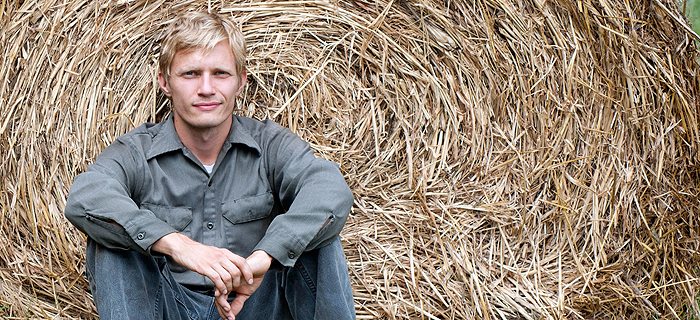
 Hall’s interest in biofuels prompted him to create an independent study program about biofuels at Berea. What started as an interest ended as a fully functional miniature biofuel plant for the college, and a career path for the young entrepreneur.
Students might have seen Hall collecting used grease from the Crossroads Café and Dining Services when he was working to create his biofuel plant. The system produced fuel for several months, and has now been moved off-campus for various reasons.
A native of southeastern Kentucky, Hall saw a need for an alternative energy sources. While the mountains of the region were being leveled for coal and the resources quickly depleted, he discovered biodiesel, a renewable recycled fuel with chemical properties similar to those of diesel, only cleaner and safer.
Biodiesel is made by mixing organic compounds — such as animal fats, soybeans and other oil producing plants — with alcohol. Recycled grease from restaurants is strained to remove pieces of food, then mixed with alcohol and a catalyst. This strips the glycerin from the oil and leaves behind the fuel, which is used in diesel powered vehicles.
Hall, who worked in an underground coal mine after completing high school, discovered the potential of biodiesel while reading a book about the subject. He realized that biodiesel could be a piece of the puzzle of economic diversification in the region and a sustainable solution to the increasing energy demand in the US.
Hall plans to start building portable biodiesel plants for schools and others in Kentucky to fuel vehicles such as school buses and to educate students about renewable energy. He recently received a grant for his company, East Kentucky Biodiesel, LLC, through the Kentucky New Energy Ventures Fund.
Hall is currently collaborating on his plan with his colleagues at Piedmont Biofuels. He has even secured four acres of land for the next five years from the Prestonsburg, KY city council which he will use as his base of operations.
Hall also pursued his interest in biofuel during his first year with the Entrepreneurship for the Public Good program. Hall and a small group of EPG fellows worked with community members in Hyden, KY to gain interest for a small biodiesel system for the area’s school buses.
For his second year of EPG, Hall worked at Piedmont Biofuels, which generates about one million gallons of fuel annually. At Piedmont, Hall not only learned new skills but also made significant contributions to the company.
For example, he worked on the installation of a continuous cavitational reactor, a system that increases the speed and efficiency of biodiesel production. But the work encountered a few bumps in the road. Hall wrote in his journal:
“During the cavitator training … a serious technical error occurred within the process flow parameters. I worked on a solution over dinner with the design build guys I was interning with, and lo and behold, that ended up being the route that was taken.”
Soon to be a graduate of Berea College, Hall wants to pursue entrepreneurship as a means of developing communities in Kentucky. He is a Francis S. Hutchins Scholar, an award given to a rising junior or senior from eastern Kentucky who submits the best work of research, art, or literature on an Appalachian topic, and has a superior academic and labor record, and demonstrates a commitment to the eastern Kentucky region.
As he embarks on his new career, Hall already has a few valuable lessons. “I must be cognizant of the need to differentiate between my desires and what the community actually wants,” he says.
“This is an important lesson and one that I intend to carry with me as I go about recognizing and developing opportunities.”